

Releasing its FY2025 results this week, the Swiss giant saw organic growth up 2.5%, with 3-4% projected for 2026.
But 2025 was a tumultuous year for Nestlé: with a scandal seeing the exit of Laurent Freixe and the appointment of Philipp Navratil in his place. Meanwhile, the ‘watergate’ scandal saw Nestlé admit to using illegal filtration methods to mask contamination in mineral water products. In October, the company announced 16,000 roles were to be cut.
But coffee remains a solid and reliable cornerstone for the Swiss giant: coffee, along with confectionery, was the largest organic growth contributor.
It’s not all plain sailing: in both coffee and confectionery, Nestlé has had to focus carefully on pricing, addressing the rising cost of key commodities such as coffee and cocoa, while also keeping costs acceptable to consumers (a challenge that has impacted margins).
But the coffee category, as a whole, remains a power area for Nestlé: and one where RTD brings a whole new level of potential.
And as the company hones its focus on four key areas, coffee is one of the largest: with CHF 25bn ($32bn) in annual sales making up 29% of the company’s sales.
But this power portfolio could come under increasing pressure from the new coffee giant created by the merger of Keurig Dr Pepper and JDE Peet’s: which is creating the world’s largest pure-play coffee company.
Instant coffee and RTD perform strongly
Despite the glamour of top brands like Nespresso, it was Nescafé’s soluble coffee that shone particularly strongly in 2025: growing double-digit and becoming Nestlé’s largest growth contributor in coffee.
Meanwhile, ‘strong momentum’ in Nescafé Espresso Concentrate and RTD coffee continues to boost Nestlé’s optimism for the category.
And this cold coffee potential can be spread across all three power brands.
“One reason we are so excited about cold coffee as a platform is the clear structural drivers it represents,” said Philipp Navratil, who was moved into the top job in September after leading the company’s coffee unit then Nespresso.
“Cold coffee serves new need states: refreshment, functionality and indulgence,” he said.
“It taps into a clear need for convenience. And it brings new consumers to coffee, driving true category expansion. It plays strongly with millennials and Gen Z, often led by influencers, capturing the suitability of cold coffee for experimentation.”
And Nestlé is uniquely placed to capture this opportunity, he continued.
“Our global leadership position and deep coffee expertise give us an advantage in innovating and scaling in this space,” he said. “You have all heard about Nescafé Espresso Concentrate. And cold coffee is so much more than that.
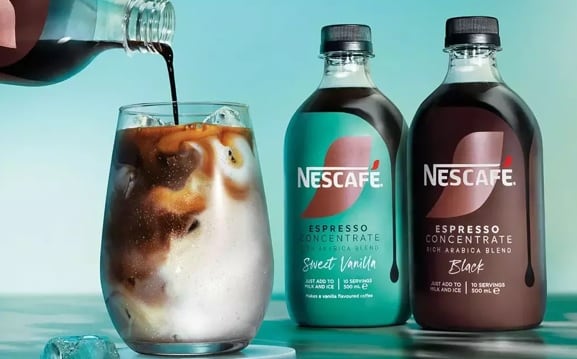
“We are bringing cold coffee to consumers across our top three brands in all formats, portioned, soluble, ready-to-drink and concentrates.
“We have launched new products across multiple markets through the last year and have a strong multiyear pipeline, including concepts like the fruit-based Starbucks Refreshers, which expand the category even further.”
Added to Nestle’s excitement in the coffee category is coffee creamers: a category which has taken off in growth and innovation.
Coffee growth areas
- Vertuo: Out-of-home grew mid single-digits, led by strong hotels, restaurants and cafés (horeca) momentum and increased machine placements.
- Digital transformation: Deployment of the Nespresso mobile app contributed to increasing basket value and purchase frequency, Starbucks direct-to-consumer received strong reception, while e-retail and marketplaces were key growth drivers of business to consumer channel.
- RTD coffee: A key way to tap into Gen Z coffee consumption
What next for Nestle Waters?
Nestlé has refocused its business into four key pillars: coffee, pet care, nutrition and food & snacks.
To date, Nespresso (which celebrates its 40th anniversary this year) has been treated as a separate division: and Navratil says this brand will continue to operated independently under a distinct, globally focused business model.
Nestlé is in talks with Froneri to offload its remaining ice cream business, which includes premium brand Haagen-Dazs; while Nestlé Health Science will become part of the nutrition division.
Top water brands such as San Pellegrino and Perrier were spun off from the main Nestlé business in 2024, with a sale of the brands now underway.
The division is expected to be deconsolidated by 2027, said Navratil.